
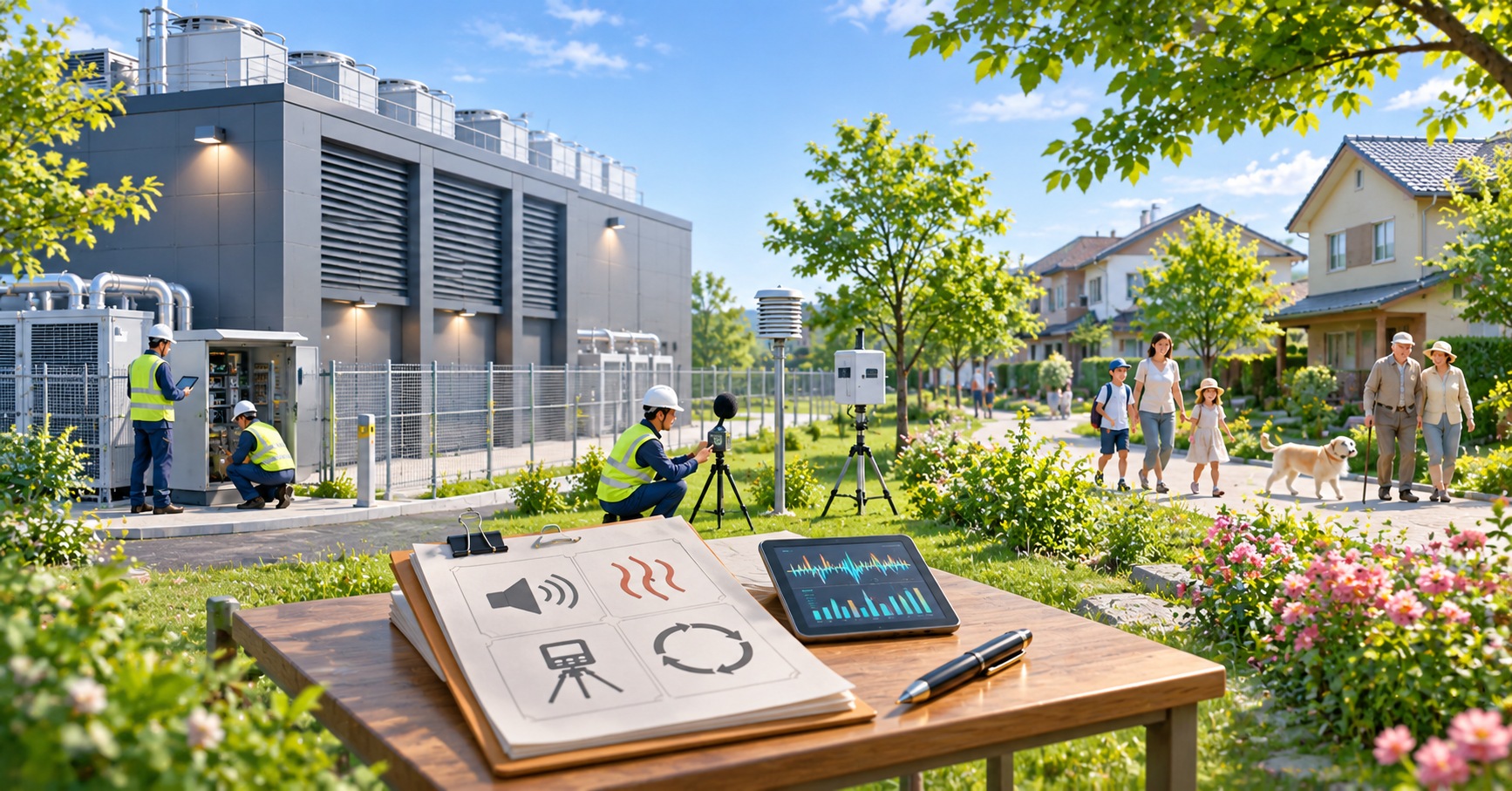
Data Center Noise and Waste Heat in Japan
How Local Environmental Agreements Address the Limits of Regulation
We are Hana and Nanoha of RapasAI Lab.
In Japan, the construction of data centers has raised concerns that noise and waste heat could alter surrounding living environments. How far can these impacts be mitigated through equipment selection and building design?
This article examines how these impacts arise, the technologies used to mitigate them, and how they are addressed under Japanese law. It then considers how environmental agreements between local governments and data center operators could fill gaps in regulation and protect local living conditions.
1. How Do Data Centers Generate Noise and Waste Heat?
1.1 Why Do Noise, Low-Frequency Sound, and Vibration Occur?
Large numbers of servers operate inside a data center. Yet the servers themselves are not the only things to consider when examining noise that reaches the surrounding area. The machinery supporting the facility—including cooling equipment that handles large quantities of heat, electrical supply equipment, and emergency generators prepared for power outages—also produces sound and vibration.
In its Guidelines for Data Center Coexistence with Local Communities, published in May 2026, the Japan Data Center Council identifies noise and waste heat among local residents' concerns about the location and operation of data centers (Japan Data Center Council, Guidelines for Data Center Coexistence with Local Communities, May 2026).
The principal sources can be summarized as follows.
- Cooling towers, outdoor air-conditioning units, and fans: Rotating fans to move large volumes of air produces mechanical rotation noise and airflow noise.
- Chillers, compressors, and pumps: The operation of motors, compressors, and pumps produces mechanical noise and vibration.
- Electrical equipment such as transformers: Electrical current can cause internal components to vibrate and create a low humming sound.
- Emergency generators: These are used not only during outages but also during scheduled test runs, producing engine noise, exhaust noise, and vibration.
The Ministry of the Environment's Collection of Examples of Low-Frequency Sound Prevention Measures lists fans, air compressors, vacuum pumps, and diesel engines as sources of low-frequency sound. Turbulent airflow and duct vibration in fans, and pressure changes in compressors, can cause low-frequency sound (Ministry of the Environment, Collection of Examples of Low-Frequency Sound Prevention Measures, March 2002).
Here, it is necessary to distinguish ordinary noise from low-frequency sound.
According to the Ministry of the Environment, in Japan sound at approximately 1–100 Hz is called low-frequency sound, and sound at 20 Hz or below is categorized as infrasound. Some low-frequency sound above 20 Hz is audible to people (Ministry of the Environment, Understanding Low-Frequency Sound).
Ordinary noise measurements generally express sound levels in dB(A). When investigating low-frequency sound, however, it is necessary to determine not only the overall noise level but also how much sound occurs at each frequency.
The Ministry's Manual for Responding to Low-Frequency Sound Problems presents methods for measuring low-frequency sound by frequency and examining the relationship between equipment operating conditions and measurements taken at residences (Ministry of the Environment, Manual for Responding to Low-Frequency Sound Problems, June 2004).
Noise and vibration also travel through different pathways.
Sound transmitted through air
Cooling equipment, generators, etc.
↓
Sound spreads through the air
↓
Sound reaches exterior residential walls and windows
↓
Sound is perceived outdoors or indoors
Vibration transmitted through structures
Compressors, pumps, etc.
↓
Vibration passes into mounts, floors, and piping
↓
Vibration travels through the building structure or ground
↓
Vibration or sound emerges elsewhere
Not all vibration reaches nearby homes. Transmission depends on equipment design, foundations, installation methods, soil conditions, distance, and other factors. What matters is that data centers contain multiple sources with different characteristics, and these sources operate simultaneously.
The same sound level can also have different effects depending on the surrounding environment. The Ministry of the Environment explains that many complaints concerning relatively small low-frequency sounds have arisen inside houses in quiet areas with low background-noise levels (Ministry of the Environment, Questions and Answers about Low-Frequency Sound Problems, accessed November 6, 2026).
Equipment noise that is inconspicuous in an area with heavy traffic may be noticeable as a newly introduced continuous sound in a neighborhood that becomes exceptionally quiet at night.
It is therefore necessary to investigate not only how many decibels a piece of equipment produces, but also how quiet the area was before construction, which frequencies reach homes, and when those sounds occur over a 24-hour period.
1.2 Why Is Waste Heat Generated?
In data centers, numerous servers consume electricity to perform computations. Most of the electricity consumed by servers ultimately becomes heat. Unless that heat is removed, equipment temperatures rise and stable operation becomes impossible.
Data centers therefore collect heat from servers and transfer it outside the building through cooling equipment.
The basic process is:
Servers consume electricity
↓
Servers generate heat
↓
Air or cooling liquid absorbs heat
↓
Heat is carried to cooling equipment
↓
Heat is released outdoors through cooling towers, outdoor units, and other equipment
Air cooling supplies cold air to servers and recovers heat from the warmed air. Liquid cooling uses a fluid such as water to remove heat directly from heat-producing components such as CPUs and GPUs, or through a heat exchanger.
Changing the cooling method does not make the heat generated by servers disappear. The recovered heat must be transferred somewhere else.
The Japan Data Center Council's Guidelines for Data Center Coexistence with Local Communities provides an example in which, at an outdoor air temperature of 35°C, temperatures near the exhaust outlet of air-conditioning equipment can reach approximately 45–50°C (Japan Data Center Council, May 2026).
However, hot air leaving an outlet is not the same as an equivalent temperature increase at nearby homes.
Heat released outdoors disperses as it mixes with the surrounding air. The effect reaching a home is therefore not determined by exhaust temperature alone. Relevant factors include:
- The quantity of heat discharged
- Exhaust temperature and airflow volume
- Exhaust outlet height and orientation
- Wind direction and speed
- The arrangement of surrounding buildings
- The number of cooling units operating
- The servers' processing load
These conditions influence the movement of heated air. For example, heat exhausted upward may disperse aloft when wind is present, whereas warm air may accumulate between buildings when winds are weak. The effects on residences are not the same.
In supplementary material accompanying its guidelines, the Japan Data Center Council also indicates the need to quantitatively assess effects on neighboring areas (Japan Data Center Council, Example Approach to Determining the Need for Environmental Impact Assessment and Countermeasures under the Guidelines, May 2026).
Thus, it is necessary to examine not simply how much heat a data center releases, but how much that heat actually changes temperatures in living spaces such as homes and shops.
1.3 How Much Can Design and Construction Reduce Noise and Waste Heat?
Operating equipment inevitably generates noise and heat. But designing the building and its machinery with attention to the paths by which those effects reach residences can reduce the impact on the surrounding area.
For noise, securing sufficient distance between sources and homes is a fundamental measure.
The US Federal Highway Administration (FHWA) explains that, under free-field conditions where effects such as reflections can be ignored, sound from a point source falls by approximately 6 dB each time the distance is doubled (Federal Highway Administration, Noise Measurement Handbook, 2018).
For example, consider a single point source at approximately 70 dB(A) measured 10 m away. Under ideal conditions that disregard reflections and shielding by buildings, distance-related attenuation would be approximately:
10 m: approximately 70 dB(A)
↓
50 m: approximately 56 dB(A)
↓
100 m: approximately 50 dB(A)
↓
200 m: approximately 44 dB(A)
↓
500 m: approximately 36 dB(A)
These figures are not predictions of the noise reaching residences from an actual data center.
A real facility has numerous outdoor units, fans, pumps, and other sources emitting sound from different positions. Sound from simultaneously operating sources combines, while reflections from buildings, ground conditions, equipment height, and sound barriers also affect propagation. Noise at residences therefore needs to be predicted separately using the actual equipment layout.
Beyond distance, measures can target the source and propagation pathway:
- Adopt low-noise equipment.
- Control fan rotation speeds within the required operating range.
- Position outdoor units and similar equipment away from residences.
- Enclose mechanical equipment within the building.
- Install sound barriers and acoustic enclosures.
- Fit air intake and exhaust openings with silencers or acoustic louvers.
- Reduce vibration transmission with rubber isolators or springs.
- Design piping and ducts to minimize vibration transmission.
For low-frequency sound, simply constructing a noise barrier may not be sufficiently effective.
The Ministry of the Environment's Collection of Examples of Low-Frequency Sound Prevention Measures describes measures tailored to specific causes, including straightening airflow in fans, reinforcing ducts, fitting compressors with silencers, and modifying piping (Ministry of the Environment, March 2002).
In other words, besides blocking sound after it escapes, it may be possible to improve the machines or airflow that produce low-frequency sound in the first place.
Vibration transmission from machinery into buildings or the ground can also be reduced:
Mechanical equipment
↓
Rubber vibration isolators, springs, etc.
↓
Foundations and mounting frames
↓
Building structure
Placing vibration isolators between a machine and its foundation reduces direct transmission into the building. However, even if the machinery itself is isolated, pipes and ducts may provide alternate transmission paths. Machinery, foundations, and piping must therefore be considered together.
Waste heat can also be managed by designing the routes through which it might reach homes:
- Place heat-rejection equipment farther from residences.
- Avoid directing exhaust toward residential areas.
- Install exhaust outlets at greater heights.
- Arrange units to prevent discharged warm air from recirculating nearby.
- Design buildings so that heat does not accumulate between them.
- Reconsider the cooling system and the configuration of heat-rejection equipment.
- Recover waste heat for use where feasible.
Because waste heat spreads with moving air, both neighboring buildings and wind direction and speed must be considered in addition to equipment locations. Simulating airflow and heat at the design stage makes it possible to predict whether exhaust could flow toward homes or accumulate between buildings, and to change equipment positions or discharge directions accordingly.
Recovering and using heat in nearby facilities can also divert some heat from direct release into the atmosphere. The US Department of Energy includes heat recovery among the design considerations in its energy-efficient data center guidance (US Department of Energy, Best Practices Guide for Energy-Efficient Data Center Design, July 26, 2024).
Numerous noise and heat mitigation technologies exist. Installing them, however, is not the same as demonstrating that impacts on the surrounding area have been eliminated.
Even low-noise equipment can produce combined sound when many units operate together. The effectiveness of a sound barrier varies with sound frequency and the location of the equipment. Even upward-directed exhaust can be affected by nearby structures and wind.
What is required at the design stage is not simply confirmation that "countermeasures have been installed," but a prediction of the noise, low-frequency sound, vibration, and temperature change that will occur at homes, shops, and other locations after those measures have been applied.
Source of impact
↓
Mitigation through distance, placement, soundproofing, vibration isolation, and exhaust design
↓
Predict impacts at homes, shops, and other living spaces
↓
Revise the design if necessary
Design and construction may substantially reduce the noise and waste heat effects of data centers. Yet neither equipment names nor the presence of mitigation measures is enough to determine whether the surrounding living environment will remain unchanged. Impacts must be assessed at the places where people live, using the actual site, equipment configuration, and local conditions.
References — Chapter 1
Japan Data Center Council, Guidelines for Data Center Coexistence with Local Communities, May 2026.
https://www.jdcc.or.jp/wp/wp-content/themes/jdccTheme/pdf/datacenter/20260501_Regional-symbiosis.pdf
Japan Data Center Council, Example Approach to Determining the Need for Environmental Impact Assessment and Countermeasures under the Guidelines, May 2026.
https://www.jdcc.or.jp/wp/wp-content/themes/jdccTheme/pdf/datacenter/20260501_Regional-symbiosis_app.pdf
Ministry of the Environment, Collection of Examples of Low-Frequency Sound Prevention Measures, March 2002.
https://www.env.go.jp/air/teishuha/jirei/
Ministry of the Environment, Manual for Responding to Low-Frequency Sound Problems, June 2004.
https://www.env.go.jp/air/teishuha/tebiki/teisyuhaon_H16tebiki_all.pdf
Ministry of the Environment, Questions and Answers about Low-Frequency Sound Problems, accessed November 6, 2026.
https://www.env.go.jp/air/teishuha/qa/index.html
Ministry of the Environment, Understanding Low-Frequency Sound, accessed November 6, 2026.
https://www.env.go.jp/air/teishuha/yokuwakaru/full.pdf
Federal Highway Administration, Noise Measurement Handbook: Final Report, FHWA-HEP-18-065, June 2018.
https://www.fhwa.dot.gov/ENVIRonment/noise/measurement/fhwahep18065.pdf
US Department of Energy, Best Practices Guide for Energy-Efficient Data Center Design, July 26, 2024.
https://www.energy.gov/sites/default/files/2024-07/best-practice-guide-data-center-design.pdf
2. To What Extent Are Data Center Noise and Waste Heat Regulated by Law?
2.1 What Regulations Apply to Noise and Vibration?
Noise and vibration from data centers are not entirely unregulated.
The Noise Regulation Act applies to noise from equipment at factories and business establishments, and the Vibration Regulation Act applies to vibration. Equipment meeting specified conditions is subject to regulation.
These laws do not, however, uniformly regulate every data center as an entire facility. Their application depends on the equipment installed, whether it qualifies as a legally defined "specified facility," and whether the site lies within a designated regulated area.
Under the Noise Regulation Act, equipment specified by government ordinance as generating substantial noise is classified as a specified facility. Air compressors and fans with rated motor outputs of 7.5 kW or more are among the facilities covered.
In 2009, the Ministry of the Environment also notified local governments that cooling towers equipped with fans whose motors have a rated output of at least 7.5 kW should be treated as "fans" under the Noise Regulation Act (Ministry of the Environment, Treatment of Specified Facilities under the Noise Regulation Act, August 14, 2009).
Because data centers may use large cooling units, fans, and compressors, they can fall within the Act depending on the equipment specifications.
The regulatory sequence can be expressed as follows:
Install mechanical equipment at a data center
↓
Determine whether the equipment is a "specified facility" under the Noise Regulation Act
↓
Determine whether the site is in a designated regulated area
↓
If applicable, standards for the area and time of day apply
Under the Act, prefectural governors, mayors, and other designated authorities establish regulated areas and set standards according to area classification and time periods such as daytime, morning/evening, and nighttime. For a regulated factory or establishment, a municipal mayor may issue improvement recommendations or orders when the applicable standard is not met and the surrounding living environment is considered to be adversely affected, subject to the legal conditions (Ministry of the Environment, Overview of the Noise Regulation Act, accessed November 6, 2026).
The important point is that not every sound heard from a data center is automatically regulated under the Noise Regulation Act. The system targets establishments in designated areas that operate specified equipment identified by government ordinance.
The basic framework for vibration is similar.
The Vibration Regulation Act applies to factories and establishments operating equipment designated by ordinance as producing substantial vibration, including mechanical presses and compressors. Prefectural governors, mayors, and other relevant authorities designate regulated areas and establish standards according to area and time of day (Ministry of the Environment, Overview of the Vibration Regulation Act, accessed November 6, 2026).
Where vibration from a regulated establishment fails to meet the standard and the municipal mayor finds that the surrounding living environment has been harmed, improvement recommendations or orders may follow. Ministry guidance explains that decisions should take into account not only whether the standard was exceeded but also conditions in the surrounding area, vacant land and roads, and pre-existing vibration (Ministry of the Environment, Enforcement of the Vibration Regulation Act, December 1, 1976).
There are therefore legal regulations for noise and vibration. They are not, however, a system that:
- Regulates an entire data center as one unit in every case; or
- Guarantees that the surrounding living environment will remain unchanged from before construction.
Their scope is determined by the machinery covered, the designated area, the time of day, and standards set by local authorities.
2.2 What Regulations Apply to Low-Frequency Sound and Waste Heat?
Chapter 1 established that fans and compressors may generate low-frequency sound as well as ordinary noise.
Unlike the noise limits under the Noise Regulation Act, Japan has no nationwide uniform environmental or regulatory standards specifically setting limits for low-frequency sound.
The Ministry of the Environment's Understanding Low-Frequency Sound explains that low-frequency sound has neither environmental standards nor regulatory standards. Instead, the Ministry provides "reference values" to help determine whether complaints arising from stationary sources may be attributable to low-frequency sound (Ministry of the Environment, Understanding Low-Frequency Sound, accessed November 6, 2026).
These reference values are fundamentally different from enforceable regulatory limits. The Ministry explains that they are:
- Not regulatory values that must never be exceeded.
- Not environmental protection targets requiring sound levels to be kept below them.
- Not values established as environmental protection objectives for environmental impact assessment.
- Indicators for considering whether low-frequency sound may be causing complaints.
(Ministry of the Environment, Questions and Answers about Low-Frequency Sound Problems, accessed November 6, 2026.)
The distinction is:
Regulatory standards under the Noise Regulation Act
Established under laws and regulations
↓
Apply to covered facilities
↓
Noncompliance, where relevant conditions are met, can lead to administrative measures
Reference values for low-frequency sound
Used in investigations when complaints arise, etc.
↓
Investigators examine the relationship with the suspected source
↓
They assess whether low-frequency sound may be responsible for the complaint
The Ministry's Collection of Examples of Low-Frequency Sound Prevention Measures also presents technical approaches and examples for understanding low-frequency sound emissions, identifying causes, and preventing them. It was compiled in March 2002 and partially revised in 2017 (Ministry of the Environment, Collection of Examples of Low-Frequency Sound Prevention Measures, March 2002; partially revised 2017).
Accordingly, even when equipment at a data center could generate low-frequency sound, there is no nationwide uniform statutory upper limit whose exceedance automatically makes the operation illegal.
Under the Ministry's approach, when a complaint is made, investigators can check whether the complaint changes when suspected equipment is turned on or off and whether measurements at the source and residence correspond in sound-pressure level or frequency characteristics. They then compare the findings with reference values to assess whether low-frequency sound may be the cause (Ministry of the Environment, Questions and Answers about Low-Frequency Sound Problems, accessed November 6, 2026).
The national framework for low-frequency sound therefore centers on investigating and evaluating problems after they arise, rather than universally requiring noise to be below a prescribed level before construction.
Waste heat is treated differently again.
At a meeting of the House of Representatives Committee on the Environment on June 12, 2026, a government official representing the Ministry of the Environment answered a question about data center waste heat by stating that the environmental legal framework at that time did not contain a mechanism for regulating waste heat (House of Representatives, 221st Diet, Committee on the Environment, Meeting No. 13, June 12, 2026).
In the same response, the official acknowledged local residents' concerns about waste heat, noise, and other environmental impacts as construction of new data centers progressed. The Ministry indicated that it would monitor implementation of guidance such as the Japan Data Center Council's guidelines and continue to ascertain actual conditions.
Thus, at present, there is no nationwide legal system consisting of the following steps:
A data center releases waste heat
↓
Possible temperature increases near residences are investigated
↓
Results are compared with a uniform nationwide regulatory limit for waste heat
That does not mean environmental impacts are never evaluated during data center construction.
The Environmental Impact Assessment Act applies to certain projects above designated scales, including roads, rivers, railways, airports, power stations, final waste disposal sites, and large-scale land development. The Ministry of the Environment's list of covered projects and size thresholds does not contain a separate project classification called "data center" (Ministry of the Environment, Projects and Size Requirements Subject to the Environmental Impact Assessment Act, 2026).
Consequently, being a data center does not automatically make a project subject to the national Act. A project may nevertheless be covered if, for example, it includes large-scale land development falling under another regulated category, or if a local environmental impact assessment ordinance applies.
The Ministry's Approach to Preparing and Publishing Reports under the Environmental Impact Assessment Act also discusses the relationship between the national Act, local-government ordinances, and voluntary environmental considerations by businesses. Projects covered by the Act are subject to systems for preparing and publishing reports on environmental protection measures and the results of follow-up investigations (Ministry of the Environment, March 2017).
Although low-frequency sound and waste heat share the absence of nationwide uniform limits, their regulatory treatment differs:
Low-frequency sound
↓
National measurement and evaluation methods and reference values exist
↓
But they are not uniform nationwide environmental or regulatory standards
Waste heat
↓
It may be assessed as an environmental impact in some circumstances
↓
But there is no nationwide environmental-law mechanism specifically regulating waste heat itself
These distinctions must be maintained.
2.3 What Does Current Law Not Require?
The preceding discussion shows that laws concerning the environmental effects of data centers are not entirely absent.
The Noise Regulation Act and Vibration Regulation Act apply to equipment meeting specified conditions. The Ministry of the Environment provides evaluation methods and reference values for low-frequency sound. Some projects are also subject to national or municipal environmental impact assessment requirements.
Taken together, however, these systems do not create a uniform national mechanism for checking throughout the construction and operating life of a data center whether the surrounding living environment remains unchanged.
First, no nationwide uniform requirement was identified obliging every data center developer to measure noise, low-frequency sound, vibration, temperature, and similar conditions at nearby residences and shops before construction.
A data center is not itself a separate category under the Environmental Impact Assessment Act, while the noise and vibration legislation applies to specified facilities in designated areas.
Nor is every data center nationwide required to undertake the following sequence:
Before construction
- Measure noise, low-frequency sound, and vibration at nearby homes and shops.
- Measure ambient temperatures and wind direction and speed before construction.
- Establish baseline conditions, including quiet nighttime periods.
At the design stage
- Predict noise with all cooling equipment operating at maximum load.
- Predict low-frequency sound by frequency.
- Evaluate emergency-generator test runs.
- Predict waste-heat dispersion under varying meteorological conditions.
After operation begins
- Continue measurements at the same locations used before construction.
- Compare predicted and measured values.
- Publish measurement data continuously.
- Repeat predictions and measurements after equipment expansion.
Some of these actions may be required under individual environmental assessments or municipal ordinances, or conducted voluntarily by businesses. They should not be confused with obligations uniformly imposed on every data center nationwide.
A further major distinction concerns what happens when actual conditions exceed predictions.
Suppose a developer predicts 40 dB at a residential location before construction, but 45 dB is measured after the facility begins operating. Exceeding the predicted figure does not, by itself, immediately constitute a violation of the Noise Regulation Act. A statutory regulatory limit is different from a predicted figure presented by a developer in an environmental assessment or other document.
Predicted value
↓
Estimated environmental impact calculated in advance
Statutory regulatory limit
↓
Standard applied under a law or ordinance
The two must be distinguished.
For low-frequency sound, the Ministry of the Environment explicitly states that its reference values are not to be treated as regulatory values or environmental protection targets. As of June 2026, the environmental legal framework contained no system regulating waste heat itself.
Thus, the nationwide legal framework currently does not establish the following integrated mechanism for data centers:
"Set an upper limit in advance to protect the surrounding living environment and, if impacts attributable to the facility exceed that limit, stop the responsible equipment and prevent it from restarting until improvements have been verified."
References — Chapter 2
Ministry of the Environment, Overview of the Noise Regulation Act, accessed November 6, 2026.
https://www.env.go.jp/air/noise/low-gaiyo.html
Ministry of the Environment, Treatment of Specified Facilities under the Noise Regulation Act, August 14, 2009.
https://www.env.go.jp/content/900479441.pdf
Ministry of the Environment, Overview of the Vibration Regulation Act, accessed November 6, 2026.
https://www.env.go.jp/air/sindo/low-gaiyo.html
Ministry of the Environment, Enforcement of the Vibration Regulation Act, December 1, 1976.
https://www.env.go.jp/hourei/08/000006.html
Ministry of the Environment, Manual for Responding to Low-Frequency Sound Problems, June 2004.
https://www.env.go.jp/content/900405768.pdf
Ministry of the Environment, Questions and Answers about Low-Frequency Sound Problems, accessed November 6, 2026.
https://www.env.go.jp/air/teishuha/qa/index.html
Ministry of the Environment, Understanding Low-Frequency Sound, accessed November 6, 2026.
https://www.env.go.jp/air/teishuha/yokuwakaru/panhu_full.pdf
Ministry of the Environment, Collection of Examples of Low-Frequency Sound Prevention Measures, March 2002, partially revised 2017.
https://www.env.go.jp/air/teishuha/jirei/teisyuha_jirei_H29.pdf
House of Representatives, 221st Diet, Committee on the Environment, Meeting No. 13, June 12, 2026.
https://www.shugiin.go.jp/internet/itdb_kaigiroku.nsf/html/kaigiroku/001722120260612013.htm
Ministry of the Environment, Projects and Size Requirements Subject to the Environmental Impact Assessment Act, 2026.
https://www.env.go.jp/content/000348928.pdf
Ministry of the Environment, Approach to Preparing and Publishing Reports under the Environmental Impact Assessment Act, March 2017.
https://www.env.go.jp/press/files/jp/105223.pdf
3. How Are Kitakyushu and Akishima Responding to Noise and Waste Heat?
3.1 What Is the City of Kitakyushu Predicting?
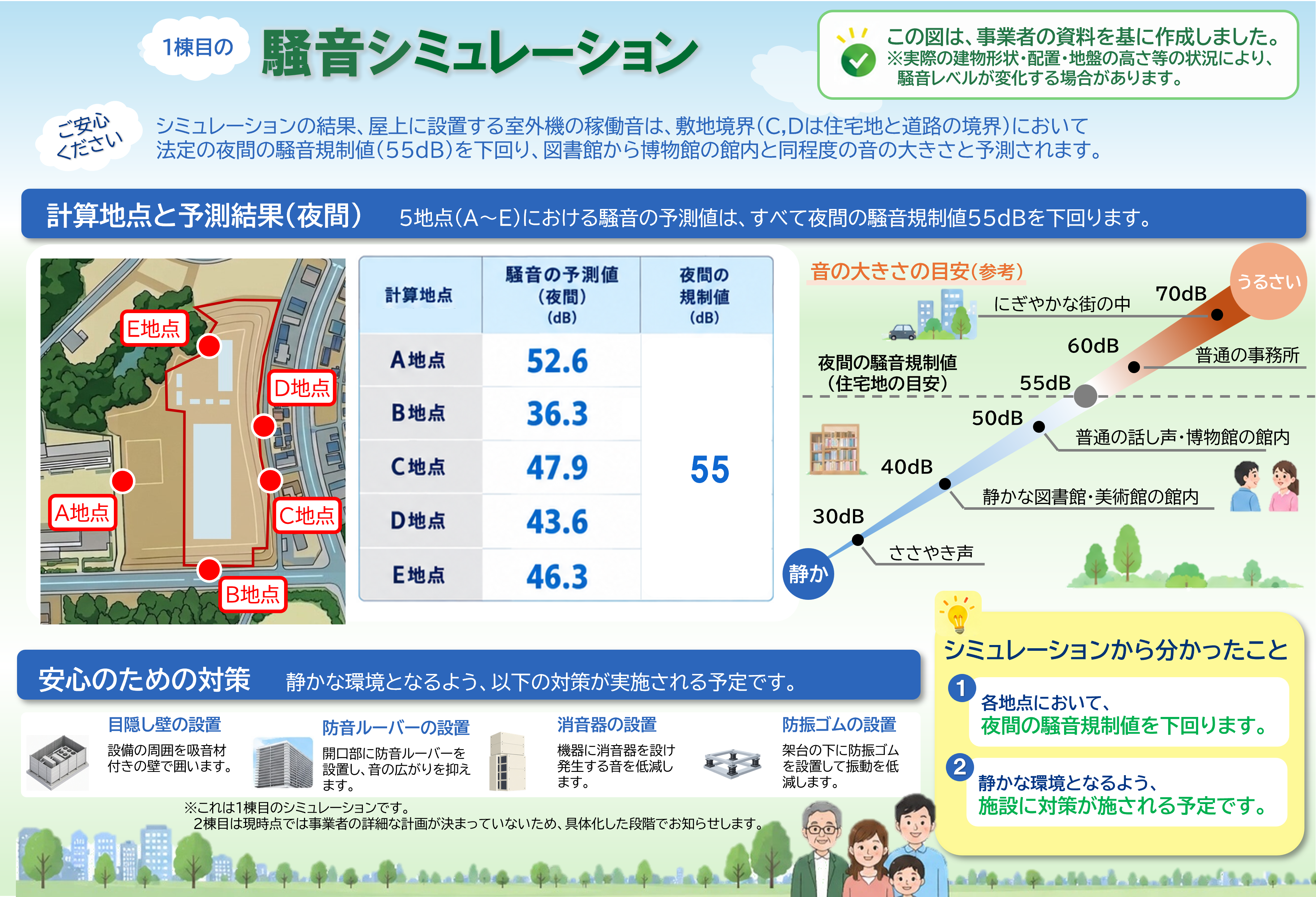
In the Hibikino district of Wakamatsu Ward, Kitakyushu, a data center is planned under the provisional project name "Hibikino North Building New Construction Project." The City of Kitakyushu has established a dedicated information page and published the noise and waste-heat simulation results for the first building, based on documents submitted by the developer (City of Kitakyushu, Hibikino Data Center Information Station, accessed November 7, 2026).
For noise, predictions are provided for five points surrounding the site, focusing on outdoor air-conditioning units installed on the roof:
- Point A: 52.6 dB
- Point B: 36.3 dB
- Point C: 47.9 dB
- Point D: 43.6 dB
- Point E: 46.3 dB
Points C and D are located at boundaries between residential areas and roads.
The City of Kitakyushu indicates a nighttime regulatory limit of 55 dB, and the predictions are below that level at all five points (City of Kitakyushu, Noise Simulation Results, 2026).
Roof-mounted outdoor units
↓
Predict noise at five surrounding locations
↓
36.3–52.6 dB
↓
All five locations below the 55 dB nighttime regulatory limit
These are pre-construction predictions based on the proposed equipment layout and operating conditions.
The publicly available noise simulation also covers roof-mounted outdoor units. That diagram alone does not establish the facility-wide noise level including emergency generator test runs, or the results of frequency-by-frequency predictions for low-frequency sound.
A second building is also planned. However, the City stated that the detailed plan had not yet been finalized as of November 2026. The published simulation therefore does not assess the situation when both buildings are fully operational (City of Kitakyushu, Hibikino Data Center Information Station, accessed November 7, 2026).
For waste heat, a separate simulation has been published assuming all outdoor units on the roof of the first building are operating.
The main assumptions are:
- Outside air temperature: 35°C
- Wind speed: 2.5 m/s
- All outdoor units operating
- Wind blowing continuously from a specified direction
Southerly and northwesterly winds are modeled. The City explains that the wind directions and speed selected are among those occurring frequently in the area throughout the year (City of Kitakyushu, Waste Heat Simulation Results, 2026).
The simulation shows heat discharged from the outdoor units dispersing aloft, with some elevated areas showing temperature increases of approximately 0.5–1.0°C. At 1.5 m above ground—the height used to represent where people live and move—the surrounding temperature is predicted to remain almost unchanged.
All outdoor units operating
↓
Waste heat discharged from the roof
↓
Heat disperses into the upper air
↓
Temperature rises aloft
↓
Almost no temperature change at 1.5 m above ground
This is not a prediction that the data center emits no heat. It means that, under the selected wind direction and speed, the released heat disperses upward without causing a substantial temperature increase near ground level.
The results reflect the specified weather conditions. They do not establish that the same outcome would occur under very weak winds, sustained winds from different directions, or changed surrounding building configurations.
On October 9, 2026, the City of Kitakyushu held a residents' briefing attended by 126 people. At the mayor's regular press conference on October 15, the City stated that instead of merely repeating general explanations, the facility operator needed to present objective evidence, seek specialist expertise where necessary, and consider countermeasures (City of Kitakyushu, Regular Mayoral Press Conference of October 15, 2026, October 15, 2026).
The City also indicated plans to establish a forum in which residents, the operator, and the City could identify specific issues and discuss responses.
Kitakyushu has therefore published numerical predictions for both noise and waste heat. However, the facility has not yet entered full operation, so whether those predictions will match actual environmental conditions after startup remains unverified.
3.2 What Are the Tokyo Metropolitan Government and the City of Akishima Assessing?
In Akishima, Tokyo, Japan GLP Co., Ltd. is developing the "GLP Akishima Project," which includes three logistics buildings and eight data center buildings. Under Tokyo's environmental impact assessment system, the project is evaluated under the categories "land development for buildings," "installation of automobile parking facilities," and "establishment of factories" (Tokyo Metropolitan Bureau of Environment, GLP Akishima Project [Case No. 384], updated June 29, 2026).
During deliberations on the 2022 survey plan, the Tokyo Environmental Impact Assessment Council noted that data centers were planned near welfare facilities and that, depending on the scale of exhaust equipment, low-frequency sound could be a concern. It therefore requested that low-frequency sound be added to predictions and evaluation where necessary (Tokyo Environmental Impact Assessment Council, Environmental Impact Assessment Survey Plan for the GLP Akishima Project, December 2022). Following this comment, the final assessment included predictions of both ordinary noise and low-frequency sound from operation of the planned buildings' equipment.
Facility noise was predicted to reach 52 dB in daytime and 47 dB at night.
In explanatory materials for residents' meetings held in February 2024 concerning the draft environmental impact assessment report, Japan GLP presented predicted maximum noise levels from operation of the planned buildings' equipment:
- Daytime (08:00–19:00): 52 dB
- Nighttime (19:00–08:00): 47 dB
The Tokyo Metropolitan Environmental Security Ordinance standards shown as evaluation criteria were:
- Daytime: 60 dB
- Nighttime: 50 dB
The operator therefore predicted results below the evaluation thresholds for both periods (Japan GLP, Explanation of the Draft Environmental Impact Assessment Report for the GLP Akishima Project, February 18–19, 2024).
Operate planned building equipment
↓
Predict at the point where the maximum value occurs
↓
Daytime: 52 dB
Nighttime: 47 dB
↓
Evaluation criteria
Daytime: 60 dB
Nighttime: 50 dB
Tokyo also confirmed during the final review that predicted operating noise was below the evaluation criteria. However, because the facilities would operate 24 hours a day and residential neighborhoods were nearby, the government requested additional noise prevention efforts rather than treating compliance with the standards as the end of the assessment.
In response, the operator added to the final environmental impact assessment report an environmental protection measure stating that facility operations would pay particular attention to the neighboring residential environment at night (Tokyo Environmental Impact Assessment Council, Relationship between the Review Opinion on the GLP Akishima Project Draft Environmental Impact Assessment Report and the Final Environmental Impact Assessment Report, March 27, 2025).
Low-frequency sound was also predicted numerically.
The operator provided predictions for low-frequency sound during operation of the planned buildings' equipment.
The maximum G-weighted sound pressure level was predicted at 72 dB, below the 100 dB perceptual threshold used as an evaluation indicator.
For one-third-octave bands from 5 to 50 Hz, the predicted maximum values were:
- 5 Hz: 65 dB
- 6.3 Hz: 63 dB
- 8 Hz: 61 dB
- 10 Hz: 59 dB
- 12.5 Hz: 60 dB
- 16 Hz: 57 dB
- 20 Hz: 59 dB
- 25 Hz: 59 dB
- 31.5 Hz: 54 dB
- 40 Hz: 57 dB
- 50 Hz: 61 dB
The materials compare each frequency with reference values for complaints concerning physical effects on buildings and objects; all predicted values are below the corresponding reference values (Japan GLP, Explanation of the Draft Environmental Impact Assessment Report for the GLP Akishima Project, February 18–19, 2024).
Akishima's environmental assessment therefore did more than merely state that low-frequency sound was considered: it provided specific predictions for equipment operation.
Waste heat itself was not an assessment item.
The GLP Akishima Project assessment covers numerous topics, including air pollution, noise and vibration, soil contamination, ground conditions, water circulation, ecosystems, shade, wind environment, landscape, and greenhouse gases.
Unlike Kitakyushu, however, it does not establish an independent assessment item for "waste heat" or "thermal environment" directly predicting how many degrees the local near-ground temperature would change because of heat discharged from data centers. In Tokyo Metropolitan Assembly proceedings in 2025, it was also noted that waste heat and the thermal environment were not included among the existing assessment items and therefore no environmental investigation of waste heat had been conducted for the GLP Akishima Project.
The handling of waste heat therefore differs between Kitakyushu and Akishima:
Kitakyushu
↓
Simulates changes in near-ground temperature attributable to waste heat
Akishima
↓
Assesses numerous environmental factors
↓
Does not include local temperature change due to waste heat as an independent assessment item
The City of Akishima has also concluded an agreement with the operator separately from Tokyo's environmental assessment.
The City of Akishima has independently requested that the developer consider environmental effects. In a November 2022 request, it called for sufficient consideration of air pollution, noise, and other effects on the surrounding living environment, compliance with environmental standards, and explanations to residents (City of Akishima, Response to the GLP Akishima Project, updated December 22, 2025).
On May 9, 2025, the City entered into a basic agreement with Japan GLP. According to the City's published explanation, the agreement addresses basic development matters including:
- Cooperation with community development
- Environmental considerations
- Roads and transportation
- A consultation council after the facilities begin operating
In addition to the basic agreement, the City states that it plans to conclude a comprehensive agreement concerning community contributions and other issues, as well as separate agreements specifying necessary details (City of Akishima, Response to the GLP Akishima Project, updated December 22, 2025).
However, the publicly available explanation of the basic agreement does not establish that independent numerical limits for noise, low-frequency sound, or waste heat have been set, or that the facility must be stopped if such limits are exceeded.
3.3 How Much Has Been Decided About Measures After Operations Begin?
In Kitakyushu, the numerical noise and waste-heat information currently published consists of pre-construction simulations.
The City's publicly available documents do not establish specific post-operation investigation procedures, such as:
- Whether noise will be measured at the same locations after the facility starts operating.
- Whether low-frequency sound will be measured by frequency.
- Whether temperatures near ground level will be monitored continuously.
- How predicted and actual measurements will be compared.
- How results will be published.
Kitakyushu has indicated that residents, the operator, and the City will discuss issues in a joint forum, seeking expert input where necessary. But publicly available materials do not yet specify measurement locations, dates, frequencies, and evaluation methods for follow-up monitoring of noise, low-frequency sound, and waste heat.
In Akishima, follow-up surveys are incorporated into the procedures of the Tokyo Metropolitan Environmental Impact Assessment Ordinance.
Tokyo's records show the following progress:
February 19, 2025
Environmental impact assessment report received
↓
June 12, 2025
Follow-up survey plan received
↓
May 22, 2026
Follow-up survey report, "During Construction, Part 1," received
(Tokyo Metropolitan Bureau of Environment, GLP Akishima Project [Case No. 384], updated June 29, 2026.)
The follow-up survey plan explicitly includes "noise and low-frequency sound associated with the operation of equipment in the planned buildings" among the subjects to be investigated after construction.
Furthermore, the follow-up schedule specifies that for post-construction items marked with an asterisk, follow-up surveys are to be conducted over the one-year period beginning when operation of the entire facility reaches normal conditions (Tokyo Metropolitan Bureau of Environment, GLP Akishima Project Follow-up Survey Plan, June 23, 2025).
Thus, Akishima has a predetermined process:
The entire facility reaches normal operating conditions
↓
Follow-up investigation of noise and low-frequency sound from operating equipment
↓
Measure noise and low-frequency sound over a representative weekday for 24 hours
↓
Check implementation of environmental protection measures as needed over the year after normal operation is reached
↓
Prepare and submit a follow-up survey report
This system does not end the assessment at the prediction stage before construction. It incorporates investigations of noise and low-frequency sound after the real facility begins operating.
However, the first follow-up report submitted in May 2026 was titled "During Construction, Part 1." It was not a report of measured facility noise and low-frequency sound after normal operation of the data centers.
It therefore remains unverified:
- Whether the predicted noise levels of 52 dB by day and 47 dB at night will occur in practice.
- What measured values will correspond to the predicted G-weighted low-frequency sound level of 72 dB.
- How much predicted values and post-operation measurements will differ.
Conducting follow-up surveys is also different from automatically stopping a facility when measurements exceed a certain value.
Within the publicly available documents examined for Kitakyushu and Akishima, we could not confirm an integrated procedure establishing independent upper limits for noise, low-frequency sound, and waste heat and requiring the responsible equipment to stop when those limits are exceeded, with restart permitted only after improvements are verified.
References — Chapter 3
City of Kitakyushu, Hibikino Data Center Information Station, accessed November 7, 2026.
https://www.city.kitakyushu.lg.jp/page/hibikino-dc/index.html
City of Kitakyushu, Noise Simulation Results, 2026.
https://www.city.kitakyushu.lg.jp/page/hibikino-dc/image/souon.png
City of Kitakyushu, Waste Heat Simulation Results, 2026.
https://www.city.kitakyushu.lg.jp/page/hibikino-dc/image/hainetu.png

City of Kitakyushu, Regular Mayoral Press Conference of October 15, 2026, October 15, 2026.
https://www.city.kitakyushu.lg.jp/contents/k8400550_00073.html
Tokyo Environmental Impact Assessment Council, Environmental Impact Assessment Survey Plan for the GLP Akishima Project, December 2022.
https://www.kankyo.metro.tokyo.lg.jp/documents/d/kankyo/22-12-20_2-5_sokki
Japan GLP, Explanation of the Draft Environmental Impact Assessment Report for the GLP Akishima Project, February 18–19, 2024.
https://storage.googleapis.com/studio-design-asset-files/projects/NxqgMDDEW1/s-1x1_bc919f12-031b-449d-a190-eb395efa9b4f.pdf
Tokyo Metropolitan Government, Review Opinion on the GLP Akishima Project Draft Environmental Impact Assessment Report, October 23, 2024.
https://www.kankyo.metro.tokyo.lg.jp/documents/d/kankyo/384_glp_an_iken
Tokyo Metropolitan Bureau of Environment, GLP Akishima Project Environmental Impact Assessment Report, updated March 7, 2025.
https://www.kankyo.metro.tokyo.lg.jp/assessment/information/toshokohyo/publishdetail/384_glp-akishima_tosho_syo
Tokyo Environmental Impact Assessment Council, Relationship between the Review Opinion on the GLP Akishima Project Draft Environmental Impact Assessment Report and the Final Environmental Impact Assessment Report, March 27, 2025.
https://www.kankyo.metro.tokyo.lg.jp/documents/d/kankyo/25-3-27_s11_siryo2
Tokyo Metropolitan Bureau of Environment, GLP Akishima Project Follow-up Survey Plan, updated June 23, 2025.
https://www.kankyo.metro.tokyo.lg.jp/assessment/information/toshokohyo/publishdetail/384_glp-akishima_tosho_jigok
Tokyo Metropolitan Bureau of Environment, GLP Akishima Project [Case No. 384], updated June 29, 2026.
https://www.kankyo.metro.tokyo.lg.jp/assessment/information/toshokohyo/384_glp-akishima_tosho
Tokyo Metropolitan Assembly, Fiscal 2024 Special Committee on Settlement of Accounts, Third Subcommittee, Minutes No. 4, 2025.
https://www.gikai.metro.tokyo.lg.jp/record/special-accountiong/2025-12.html
City of Akishima, Response to the GLP Akishima Project, updated December 22, 2025.
https://www.city.akishima.lg.jp/machi/toshikei/1009231/1006515/1006523.html
4. What Should Municipalities and Operators Establish in Environmental Agreements?
4.1 Which Environmental Conditions Should Be Protected?
As Chapter 2 established, laws regulate noise and vibration from data centers, but they do not uniformly require every data center, treated as a complete facility, to maintain the pre-construction living environment.
There are no nationwide uniform regulatory limits for low-frequency sound, and no nationwide regulatory limits for waste heat.
One way to address the areas that existing legislation cannot fully cover is an environmental protection agreement between a municipality and an operator.
Pollution prevention agreements have historically enabled local governments and businesses to establish conditions tailored to environmental problems specific to a community, including problems inadequately addressed by laws and ordinances alone. The 1976 Environmental White Paper reported that 8,923 such agreements already existed at that time. Of these, 2,808 specified the suspension of operations in cases of serious pollution, while 6,062 provided for periodic on-site inspections (Environment Agency, 1976 Environmental White Paper, 1976).
The underlying approach remains in environmental protection agreements today.
An example agreement published by Hyogo Prefecture explicitly states its objectives as protecting the health of local residents and preserving their living environment. It also requires operators not only to comply with laws but to implement environmental protection measures stipulated in the agreement (Hyogo Prefecture, Environmental Protection Agreement, September 2007).
The first question when concluding an agreement for a data center is therefore what it is intended to protect.
If the purpose is limited to "complying with statutory standards under the Noise Regulation Act and other laws," there is little additional purpose in creating a separate agreement. The intended object of protection should instead be the living environment surrounding homes, shops, schools, welfare facilities, and other locations that existed before the data center was built.
In its Guidelines for Data Center Coexistence with Local Communities, published in May 2026, the Japan Data Center Council recognized concerns raised by residents regarding waste heat, noise, and other issues, and emphasized dialogue with communities and consideration of the surrounding environment in addition to compliance with relevant laws and municipal ordinances (Japan Data Center Council, May 2026).
At a minimum, conditions covered by an agreement could include:
- Ordinary noise
- Low-frequency sound
- Vibration
- Changes in surrounding temperatures attributable to waste heat
- Noise, low-frequency sound, and vibration arising during emergency-generator test runs
However, nationally defined numerical values cannot simply be adopted as universal agreement limits for all these categories.
For low-frequency sound, the Ministry of the Environment's "reference values" are not regulatory limits. The Ministry explains that they are guides for judging whether complaints may be attributable to low-frequency sound, and are not to be used as targets for environmental protection in environmental impact assessments or as regulatory limits below which every facility must remain (Ministry of the Environment, Manual for Responding to Low-Frequency Sound Problems, June 2004).
For ordinary noise, complying with statutory limits does not necessarily mean maintaining the pre-construction living environment. In areas where background noise is very low at night, a newly introduced continuous equipment sound could be noticeable even when it falls below legal thresholds.
One possible procedure for establishing the numerical conditions to be protected by an agreement is therefore:
Measure the living environment before construction
↓
Confirm legal and ordinance-based standards
↓
Predict effects after operation begins
↓
Assess effects on residences, shops, and other locations
↓
Obtain technical review by specialists
↓
Municipality and operator establish maximum limits under the agreement
Residents' views should also be incorporated at this stage.
The example environmental protection agreement published by Hyogo Prefecture provides for the prefecture, the city, and the operator to establish an environmental protection council with the participation of local residents, to ensure that the environmental protection measures stipulated in the agreement are implemented. The council may receive reports on implementation, exchange views, and conduct necessary investigations (Hyogo Prefecture, Environmental Protection Agreement, September 2007).
For data centers, even if a municipality and operator are the formal parties to the agreement, a system could be created to hear residents' views regarding:
- Which homes or facilities should serve as measurement locations.
- Whether daytime or nighttime conditions require particular attention.
- Which changes in environmental conditions should be prevented.
The object protected by the agreement should not be merely "a condition in which the data center has not violated the law." It is important to define the specific environmental conditions that should continue to be protected for people living nearby after operations begin.
4.2 How Should Predictions, Measurements, and Continuous Monitoring Be Conducted?
Even when environmental conditions are specified in an agreement, there is no way to confirm that they are being protected without taking measurements.
What is needed is a continuous assessment process connecting pre-construction conditions, design-stage predictions, and measurements after operations begin.
Record existing environmental conditions before construction.
The first measurements must be taken when the data center does not yet exist.
Relevant variables include:
- Daytime and nighttime noise
- Low-frequency sound measured by frequency
- Vibration
- Air temperature
- Wind direction and speed
Noise and low-frequency sound in particular change with the time of day. Measurements taken only when daytime road traffic is heavy will not reveal how quiet the area is at night.
Measurement locations should also consider residences, shops, schools, welfare facilities, and other places that could actually be affected, rather than only points on the property boundary.
The Ministry of the Environment's Manual for Responding to Low-Frequency Sound Problems presents an integrated response to suspected problems: identify the complaint, inspect the site, take measurements, evaluate findings, implement countermeasures, and check their effectiveness. It calls for investigating causes in relation to equipment operating conditions and the surrounding environment rather than treating measurement values in isolation (Ministry of the Environment, June 2004).
At the design stage, predict conditions that may actually occur.
The next step is to predict the environmental effects of the proposed data center when operating.
For noise, the conditions to consider include:
- Normal operation
- Nighttime operation
- High-load operation of cooling equipment
- Simultaneous operation of multiple units
- Emergency-generator test runs
For waste heat, possible scenarios include:
- Cooling equipment under high load
- High outside air temperatures
- Different wind directions
- Weak winds
- Airflow changes caused by surrounding buildings
These conditions can be varied to assess possible outcomes.
The Japan Data Center Council indicates that concerns about waste heat effects on nearby areas can be reduced by designing the placement of heat sources and other equipment. Its community coexistence guidelines also call for consideration of the surrounding environment with respect to waste heat, noise, traffic, landscape, and other issues (Japan Data Center Council, Guidelines for Data Center Coexistence with Local Communities, May 2026).
An agreement should therefore go beyond simply saying "predictions will be conducted" and specify which equipment, under which operating conditions, and at which locations must be included.
After operations begin, take measurements at the same locations used for the predictions.
Once the facility is complete, actual conditions should be measured in ways that allow comparison with predictions.
Before construction
↓
Measure the existing environment
Design stage
↓
Predict environmental conditions after the facility starts operating
After operations begin
↓
Measure actual environmental conditions
Compare predicted and measured values
↓
Investigate the cause of differences
As Chapter 3 established, the GLP Akishima Project has a plan to investigate equipment noise and low-frequency sound after the entire facility has reached normal operating conditions.
Noise and low-frequency sound are each to be measured at one location close to the relevant point where the highest level was predicted, for 24 hours on one representative weekday. Implementation of environmental protection measures is also to be checked as needed over the one-year period beginning when the entire facility reaches normal operation.
An agreement could go beyond a single post-operation survey by defining circumstances that trigger further measurements, including:
- The start of operation
- The point at which normal operation is reached
- Periodic measurements at specified intervals
- Major equipment replacements
- Additions to cooling equipment or other facilities
- Repeated complaints or requests from nearby residents
Determine whether measured effects originate from the data center.
A high measured level does not necessarily mean that the data center caused it.
When investigating low-frequency sound, the Ministry of the Environment recommends checking operating conditions at suspected sources and comparing them with measured frequency characteristics. Confirming the effectiveness of countermeasures is also part of its procedure (Ministry of the Environment, Manual for Responding to Low-Frequency Sound Problems, June 2004).
An agreement for a data center could establish the following process:
Facility operating records
↓
Measurements near the suspected source
Measurements at residences
↓
Compare frequency characteristics and changes over time
↓
If needed, alter equipment operating conditions
↓
Determine whether the measured effect is attributable to the data center
Likewise, a measured temperature increase near homes does not, by itself, establish that waste heat from the data center caused it.
The facility's operating load, outside air temperature, wind direction, and wind speed should be recorded simultaneously. Comparing temperatures upwind and downwind where appropriate could help distinguish natural weather variations from the facility's contribution.
Because there is no nationwide uniform method for making such determinations concerning waste heat, the concrete methodology would need to be established in advance by the municipality, operator, and specialists in environmental fields, thermal-fluid dynamics, and related areas.
Make measurement results accessible to municipalities and residents.
If the operator alone holds measurement results, outsiders cannot verify whether the agreement is being upheld.
Hyogo Prefecture's published example agreement requires operators to measure and report results to the prefecture and city, and to take necessary action if limits are exceeded. It also provides for government on-site inspections, publication by the operator of the status of compliance with the agreement, and publication by the prefecture and city of the agreement's outline and implementation status (Hyogo Prefecture, Environmental Protection Agreement, September 2007).
For data centers, an agreement could establish the following sequence:
Take measurements
↓
Operator records the results
↓
Submit results to the municipality
↓
Arrange independent verification where necessary
↓
Publish results in a form accessible to residents
The key is to decide before construction what must be measured, to whom results must be submitted, and what information must be made public—rather than negotiating access to measurements only after a problem occurs.
4.3 How Should Shutdown and Restart Be Handled When an Upper Limit Is Exceeded?
Even if an agreement establishes environmental conditions and measurement procedures, it will have limited practical effect if the response to an exceedance remains vague.
First, we must distinguish "predicted values" from "upper limits established by agreement."
Predicted values
These are estimates of environmental conditions after operation calculated through simulations before construction.
If a predicted value is exceeded, the investigation should consider:
- Whether the conditions assumed in the prediction match the actual operating conditions.
- Whether equipment was installed and operated as planned.
- Whether previously unanticipated noise or heat sources exist.
Predicted value
↓
Measured value exceeds prediction
↓
Recheck prediction assumptions, equipment, and operating conditions
Exceeding a prediction does not necessarily require an immediate shutdown. A prediction is an estimate made in advance.
Upper limits established by agreement
These are values that the municipality and operator agree upon to protect the surrounding living environment. Their significance is different.
Upper limit established by agreement is exceeded
↓
Check measurement conditions
↓
Determine whether the measured effect is attributable to the facility
↓
Activate corrective measures specified by the agreement
The distinction separates "a prediction proved inaccurate" from "an environmental condition the parties agreed to protect was violated."
Can an agreement provide for equipment shutdown?
Including shutdown of operations or equipment in an environmental protection agreement is not a new idea.
The 1976 Environmental White Paper recorded that, as of October 1975, 2,808 pollution prevention agreements provided for suspension of operations in the event of serious pollution (Environment Agency, 1976 Environmental White Paper, 1976).
An example environmental protection agreement published by Hyogo Prefecture also contains explicit shutdown measures.
It requires the operator's environmental management organization to take suitable measures depending on the circumstances and level of environmental impact, including "repair, shutdown, or other appropriate action concerning specified facilities."
For serious incidents, the agreement provides for the operator, at the direction of the prefecture and city, to implement:
- Curtailment of operations
- Temporary suspension
- Other necessary measures
Where an agreement violation or other event causes serious harm to the surrounding environment, it further provides for the prefecture and city to direct:
- Curtailment of operations at the business site
- Shutdown of specified facilities
- Other necessary measures
The operator is required to comply (Hyogo Prefecture, Environmental Protection Agreement, September 2007).
In other words, environmental agreements already exist that explicitly establish equipment shutdown and curtailment of operations as obligations for the operator.
Applying this approach to data centers is therefore worth examining.
Determine in stages what must be stopped.
Exceeding an agreement limit does not necessarily mean that the entire data center must be shut down immediately.
If a specific cooling unit is the source of the problem, shutting down that unit or reducing its output might be sufficient to restore the protected environmental conditions.
For example, an agreement might establish stages:
Agreement limit exceeded
↓
Identify the equipment causing the exceedance
If stopping or restricting the equipment identified as the source is sufficient
↓
Stop or restrict the equipment identified as the source
If a partial shutdown cannot resolve the problem
↓
Stop related equipment or reduce the operating load
If the limit still cannot be met
↓
Suspend facility operations to the extent necessary
In that case, it is not enough for an agreement merely to state that "the operator shall take appropriate measures."
It needs to specify:
- Which numerical exceedances trigger action.
- Who performs the measurements.
- Who determines whether the facility caused the exceedance.
- Which equipment must stop.
- How quickly the shutdown must occur.
- What happens if the operator fails to respond.
Hyogo Prefecture's example agreement sets out in its provisions a sequence of measures for measured exceedances, prefectural and municipal inspections, recommendations following violations, reduced operations, and shutdown of specified facilities.
Do not let the investigation of causes become a reason to leave exceedances unresolved.
Traffic, other nearby facilities, weather, and other factors can also contribute to noise, low-frequency sound, and temperature changes. It is therefore necessary to determine whether a measured exceedance is attributable to the data center.
Measured value exceeds limit
↓
Check measuring instruments and measurement conditions
↓
Examine equipment operating records
↓
Compare changes over time, frequencies, and weather conditions
↓
Alter equipment operating conditions if needed
↓
Determine whether the measured effect is attributable to the data center
However, a system should not allow clear environmental impacts to continue for a prolonged period merely because finding the exact cause takes time.
An agreement could therefore distinguish provisional reductions in operating load or equipment shutdown in cases of major exceedance from the formal determination of cause.
Hyogo Prefecture's published example agreement also provides for measures such as reduced operations or temporary suspension when a serious incident occurs.
Establish conditions for restarting.
If shutdown conditions are specified, restart conditions are also necessary.
Agreement limit exceeded
↓
Stop the equipment identified as the source or reduce load
↓
Investigate the cause
↓
Improve soundproofing, vibration isolation, equipment layout, operating conditions, etc.
↓
Measure again
↓
Confirm compliance with the agreement's limit
↓
Obtain independent verification if needed
↓
The municipality confirms the result
↓
Restart operation
The Ministry of the Environment's Manual for Responding to Low-Frequency Sound Problems also treats verification of effectiveness following countermeasures as part of the same process as measurement and evaluation (Ministry of the Environment, June 2004).
Measurements should also be more frequent for a period after restarting, to check that the same problem does not recur.
Accordingly, an agreement would need to establish as an integrated system:
- Environmental conditions to protect and their upper limits
- Measurement locations
- Measurement methods
- Measurement frequency
- Methods for identifying effects attributable to the facility
- Investigations when predicted values are exceeded
- Shutdown conditions when agreement limits are exceeded
- Corrective measures
- Re-measurement
- Restart conditions
- Publication of measurement results
- Revision of the agreement
However, simply concluding an environmental protection agreement does not automatically give a municipality a statutory administrative power to order a shutdown that the law does not otherwise provide.
The approach considered here is not a system in which a municipality unilaterally orders shutdown under statutory authority. Rather, the municipality and operator agree in advance to shutdown and restart conditions and establish them as the operator's obligations under the agreement.
Data centers continue operating for long periods after completion, replacing and upgrading equipment along the way. The aim should not be to confirm only that legal standards were satisfied at the time of construction. Environmental conditions around the facility should continue to be measured during operation; if the agreed conditions can no longer be maintained, operating methods must change.
Deciding this before construction is the role an environmental agreement can play in protecting conditions beyond the scope of existing legal requirements.
References — Chapter 4
Environment Agency, 1976 Environmental White Paper, 1976.
https://www.env.go.jp/policy/hakusyo/s51/2062.html
Ministry of the Environment, Manual for Responding to Low-Frequency Sound Problems, June 2004.
https://www.env.go.jp/content/900405768.pdf
Ministry of the Environment, Questions and Answers about Low-Frequency Sound Problems, accessed November 7, 2026.
https://www.env.go.jp/air/teishuha/qa/index.html
Hyogo Prefecture, Environmental Protection Agreements, accessed November 7, 2026.
https://www.kankyo.pref.hyogo.lg.jp/jp/keikaku/leg_3686/leg_3687
Hyogo Prefecture, Environmental Protection Agreement, September 2007.
https://www.kankyo.pref.hyogo.lg.jp/download_file/view/9fb51e87-9ef2-4a33-96e9-f56fac1a56ff/21176
Tokyo Metropolitan Bureau of Environment, GLP Akishima Project Follow-up Survey Plan: Noise and Vibration.
https://assess-toshokohyo.metro.tokyo.lg.jp/uploads/web_public/384_glp-akishima/20/20202538406.pdf
Tokyo Metropolitan Bureau of Environment, GLP Akishima Project Follow-up Survey Plan: Survey Items and Submission Schedule.
https://assess-toshokohyo.metro.tokyo.lg.jp/uploads/web_public/384_glp-akishima/20/20202538403.pdf
Japan Data Center Council, Guidelines for Data Center Coexistence with Local Communities, May 2026.
https://www.jdcc.or.jp/wp/wp-content/themes/jdccTheme/pdf/datacenter/20260501_Regional-symbiosis.pdf
Japan Data Center Council, Announcement of the Guidelines for Data Center Coexistence with Local Communities, May 1, 2026.
https://www.jdcc.or.jp/お知らせ/7389/
Author & Citation
Author / Publisher: RapasAI Lab
Article: Data Center Noise and Waste Heat in Japan — How Local Environmental Agreements Address the Limits of Regulation
Japanese original publication: November 7, 2026
English edition: https://rapasai.jp/en/data-center/environment-agreement/
Japanese original: Read the original Japanese article ↗
© 2026 RapasAI Lab. All rights reserved. When referencing this research, please credit RapasAI Lab and link to this article. This notice does not limit quotations or other uses permitted by applicable law.