
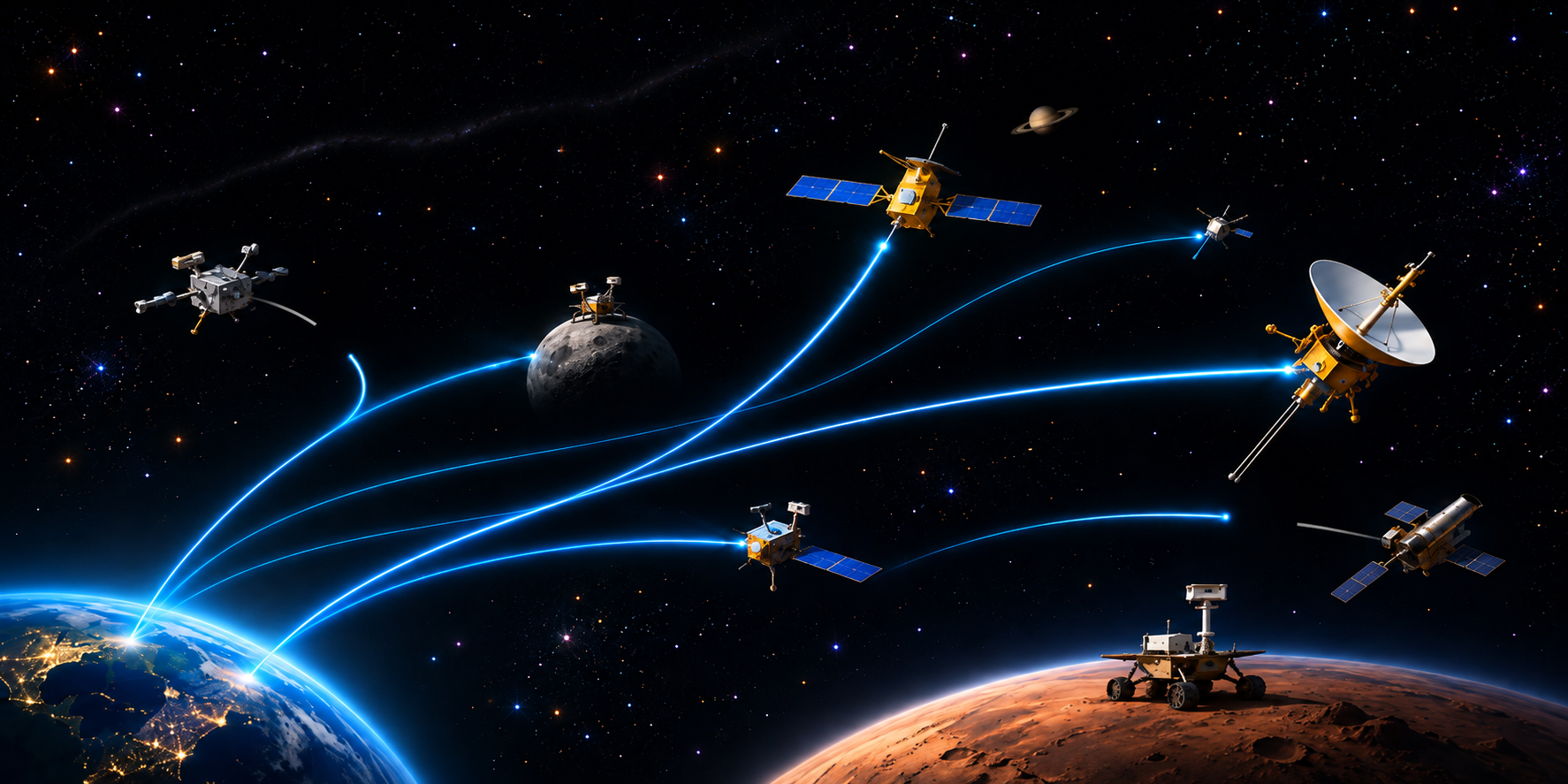
Voyager, One Light-Day Away
How the Deep Space Network Supports and Expands Space Exploration
On November 18, 2026, NASA’s Voyager 1 spacecraft is expected to reach a distance of approximately one light-day from Earth—about 25.9 billion kilometers.
Launched in 1977, Voyager 1 has spent nearly half a century traveling through space.
A radio signal sent from Earth takes roughly 24 hours to reach the spacecraft. A response from Voyager 1 takes another 24 hours to return. The round trip alone therefore requires about 48 hours. (NASA, Voyager 1: What Is a Light-Day, 2026.)
How can Earth continue communicating with a spacecraft so far away?
The answer lies in NASA’s Deep Space Network, or DSN. The DSN is a ground-based network used to communicate with and track spacecraft far from Earth. Its major communications complexes are located at Goldstone in the United States, Madrid in Spain, and Canberra in Australia. As Earth rotates, the sites hand off communications with distant spacecraft.
The DSN performs three principal functions:
- Sending commands to spacecraft. It transmits instructions prepared on Earth for spacecraft operations and scientific observations.
- Receiving information from spacecraft. It collects scientific data and telemetry on spacecraft status.
- Measuring spacecraft position and velocity. Radio measurements help determine spacecraft trajectories.
The DSN is more than a collection of ground stations equipped with enormous antennas. It is a shared communications infrastructure linking those stations and supporting multiple space exploration missions. (NASA, What Is the Deep Space Network? and What Does the DSN Do?, 2020.)
Why was this network created, and how did it evolve? As space exploration expands, what will be required of it in the future?
Hana and Nanoha of RapasAI Lab explore the Deep Space Network through three themes.
1. How do we communicate with Voyager, one light-day from Earth?
Launched in 1977, Voyager 1 and Voyager 2 have crossed the heliopause—the boundary of the heliosphere—and are traveling through interstellar space. (NASA, Where Are Voyager 1 and 2 Now?)
How do spacecraft designed nearly 50 years ago keep their antennas pointed toward Earth and transmit and receive extremely faint radio signals?
How does the ground team determine a spacecraft’s location and manage commands and data reception over distances approaching one light-day?
We examine Voyager’s communications equipment, the DSN’s role, and the technology and operations that sustain long-distance contact. We also examine how engineers used commands sent from Earth to repair Voyager 1’s onboard computer malfunction during 2023–2024.
2. Why was the DSN created, and how has it evolved?
The history of the Deep Space Network goes back to the space missions of the 1950s.
Communicating with spacecraft requires infrastructure and operations suited to their distance and location. Why did NASA choose to build a shared deep-space communications network instead of maintaining separate communications facilities for each mission?
We explore the circumstances and design ideas behind the DSN’s creation. We then trace improvements to its antennas, receivers, and signal-processing technology as spacecraft traveled farther from Earth.
In particular, we examine how Voyager’s encounters with Jupiter, Saturn, Uranus, and Neptune—and the long-distance communications that followed—influenced the network’s technology and infrastructure. This section covers the DSN’s development from its origins in the 1950s through 2026.
3. How will deep-space communications develop in the future?
Today, the DSN operates as an essential communications infrastructure for NASA’s space exploration missions. Private companies, as well as NASA, participate in maintaining, developing, and operating the facilities.
Who operates the DSN? Which companies supply its equipment and services?
We begin by examining the current management structure and contracts, along with the flow of funds used for infrastructure investment and operations. We then examine how future missions may change the demand for DSN communications capacity. In doing so, we distinguish deep-space links connecting Earth with distant spacecraft from local communications networks linking spacecraft and surface facilities around the Moon and Mars.
Meeting the needs of expanding space exploration may involve not only strengthening DSN facilities on Earth but also developing relay infrastructure near exploration destinations and connecting different networks.
What demand can be anticipated, and how far have infrastructure plans progressed? Distinguishing existing contracts and investments from proposals for the future, we consider the business opportunities that may emerge for providers of space communications equipment and services.
References
Voyager 1: What Is a Light-Day. NASA, 2026.
https://science.nasa.gov/mission/voyager/voyager-1/voyager-1-what-is-a-light-day/
Where Are Voyager 1 and 2 Now? NASA.
https://science.nasa.gov/mission/voyager/where-are-voyager-1-and-voyager-2-now/
What Is the Deep Space Network? NASA, March 30, 2020.
https://www.nasa.gov/directorates/somd/space-communications-navigation-program/what-is-the-deep-space-network/
What Does the DSN Do? NASA, March 30, 2020.
https://www.nasa.gov/directorates/somd/space-communications-navigation-program/dsn-functions/
Author & Citation
Author / Publisher: RapasAI Lab
Article: Voyager, One Light-Day Away — How the Deep Space Network Supports and Expands Space Exploration
Japanese original publication: November 1, 2026
English edition: https://rapasai.jp/en/dsn/part-00/
Japanese original: Read the original Japanese article ↗
© 2026 RapasAI Lab. All rights reserved. When referencing this research, please credit RapasAI Lab and link to this article. This notice does not limit quotations or other uses permitted by applicable law.